


Does winter have you feeling tired or blue? You’re not alone. This episode dives into the science of Seasonal Affective Disorder (SAD), from drop in serotonin to 10,000-LUX hacks to help you find your glow.
In this Episode:
- 00:00 – Intro, and Charlie Converses with Neil deGrasse Tyson
- 03:08 – Tips on Longevity: 100-year Old Albert, Be Honest, Be Nice, Be Kind – and Be Determined
- 06:46 – Recipe of the Week: Polish Ham Roll-Ups
- 07:42 – Do You Feel a Winter Slump? Learn Why
- 08:46 – The Connection Between Light and Mood
- 09:51 – Light Therapy for Seasonal and Non-Seasonal Depression
- 12:24 – Discussion: Time Changes, Indoor Work, Artificial Light
- 17:07 – How to Be Proactive to Prevent Seasonal Mood Disorders
- 20:14 – Outro
The Science Behind the Winter Slump
Learn why January feels emotionally heavier for so many people and how seasonal changes in light can directly affect mood, energy, and motivation. This episode explores Seasonal Affective Disorder (SAD), the “winter blues,” circadian rhythm disruption, serotonin and dopamine changes, and the research behind bright-light therapy—including why a 10,000-lux light box is often recommended.
This video helps explain why we get the winter blues.
The Lux Factor: Why Your Kitchen Light Isn’t Enough
The core issue: Circadian Desynchronization. When the light disappears, the brain’s “master clock” (the suprachiasmatic nucleus) loses its primary cue. But not just any bright lamp will do. A 10,000 lux standard is key to breaking the winter blues.
| Light Source | Intensity (Lux) | Effectiveness for SAD |
| Typical Indoor Light | ~300 – 500 lux | Ineffective |
| Overcast Day | ~1,000 – 2,000 lux | Minimal |
| SAD Light Box | 10,000 lux | Clinical Standard |
| Direct Sunlight | Up to 100,000 lux | Gold Standard |
How to Select and Use a SAD Light Box
You don’t have to be ‘clinically depressed’ to deserve help. If you’ve lost just 10% of your energy, your joy, or your motivation this winter—that is enough. Don’t let the darkness steal your peak experiences. Get a 10,000 lux light box, get outside, and reclaim your light.
Listen to learn other practical tips for protecting your mental health during the dark winter months to potential benefits of light therapy for non-seasonal depression.
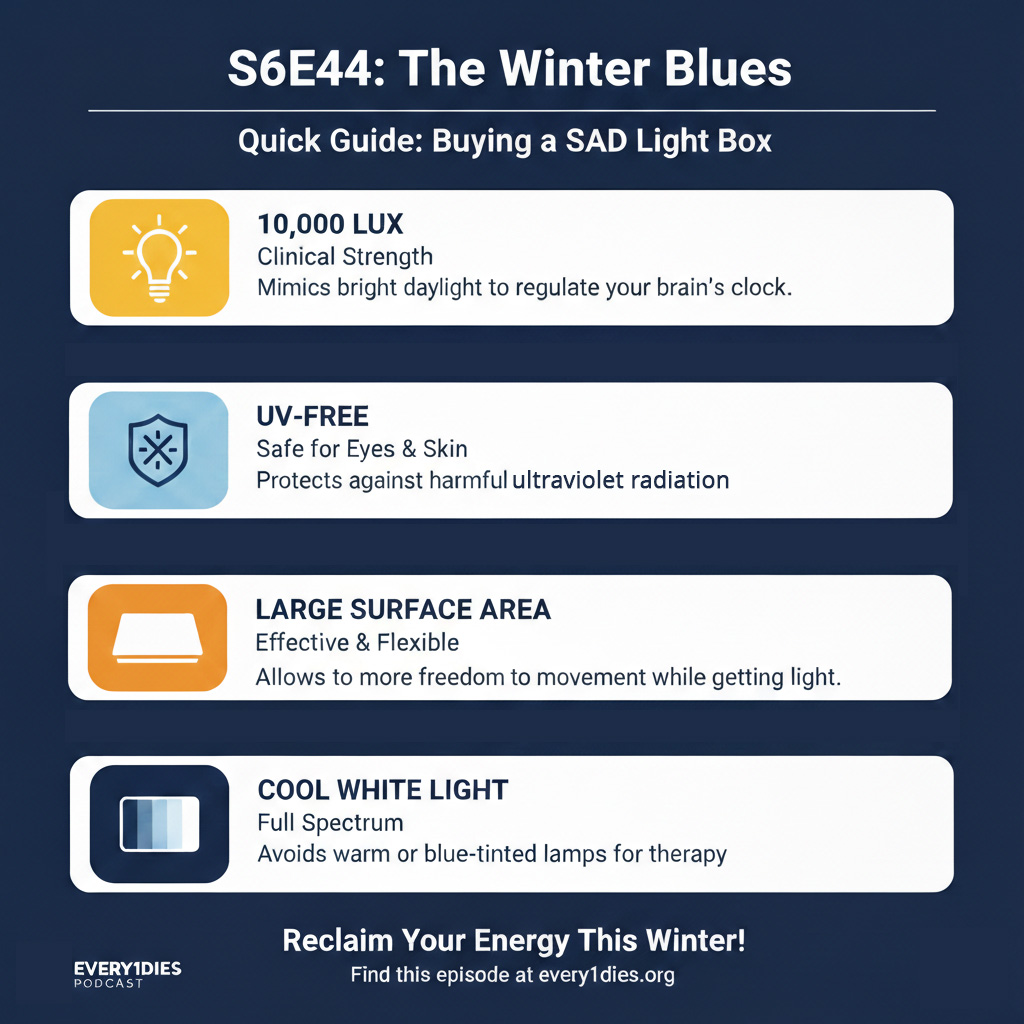
In the video below Dr. Kavoor explains how to pick and optimize SAD lamps (remember 10,000 LUX or higher!) . He says:
- The Big Distinction: He clarifies that Sunrise Alarm Clocks (which wake you up gradually) and SAD Lamps (used for therapy after you wake up) are two different tools with different purposes [01:09].
- The “30-30-30” Rule: For optimal results, he explains that a SAD lamp should ideally be placed about 30 centimeters (1-2 feet) away, at a 30-degree angle, and used for about 30 minutes consistently [07:44].
- Consistency is Key: Beneficial effects typically aren’t seen until after 3 to 4 days of consistent morning use [09:01].
For more tips on picking a light box, watch this video for selecting a box, positioning, and confirmation that they are safe for your eyes: Is Light Therapy For Seasonal Affective Disorder Safe For Eyes? Eye Doctor Explains

Recipe of the Week
This week in honor of Albert Pollack’s inspiring story, we featured Polish Roll-Ups. Be sure to listen to this 100-year old’s outlook on life and the need to help others.
References:
- People in Their Nineties Share Tips for Longevity and Living Well
- How to prepare for winter seasonal depression this fall – The Washington Post
- How to get the most out of using a light box for seasonal depression – The Washington Post
- Outcomes One and Two Winters Following Cognitive-Behavioral Therapy or Light Therapy for Seasonal Affective Disorder | American Journal of Psychiatry
- Surface facial electromyography, skin conductance, and self-reported emotional responses to light- and season-relevant stimuli in seasonal affective disorder – ScienceDirect
- Randomized Trial of Cognitive-Behavioral Therapy Versus Light Therapy for Seasonal Affective Disorder: Acute Outcomes | American Journal of Psychiatry
- Bright Light Therapy for Nonseasonal Depressive Disorders: A Systematic Review and Meta-Analysis | Depressive Disorders | JAMA Psychiatry | JAMA Network
Resources

- Light therapy for preventing seasonal affective disorder – Nussbaumer‐Streit, B – 2019 | Cochrane Library
- Expert Tips for Coping With Winter Seasonal Depression | NTD
- Determination: Through the Holocaust, War, and Beyond- A memoir by Albert Pollack.
ISBN-10 : 1732519196 | ISBN-13 : 978-1732519190 | Available here: https://a.co/d/8tZwrKk - Defeating SAD (Seasonal Affective Disorder): A Guide to Health and Happiness Through All Seasons by Norman E. Rosenthal M.D. Available here: https://a.co/d/815UtHE
Everyone Dies: and yes, it is normal!

Everyone Dies (and yes, it is normal) is a story about a young boy named Jax who finds something special on the beach where he and his grandpa Pops are enjoying a wonderful day. Pops helps Jax understand that death is a normal part of life. This book provides an age appropriate, non-scary, comfortable way to introduce the important topic of mortality to a preschool child. Its simple explanation will last a lifetime. Autographed copies for sale at: www.everyonediesthebook.com. Also available at Amazon
Mourning Jewelry

We offer a way to memorialize your loved one or treasured pet with a piece of handmade jewelry. When people comment on it and the wearer can say for example “I received this when my mother died” which opens the conversation about this loss. All our jewelry is made with semi-precious stones and beads, vintage beads, and pearls. You can choose between earrings or bracelets and the color family. Learn More
Make a Tax-Deductible Donation Here:
Subscribe & Hit That Bell So You Don’t Miss a Podcast!

https://blog.feedspot.com/palliative_care_podcasts/




It will help us in a way that it would be a lot more