
How to Find Hope in Uncertain Times
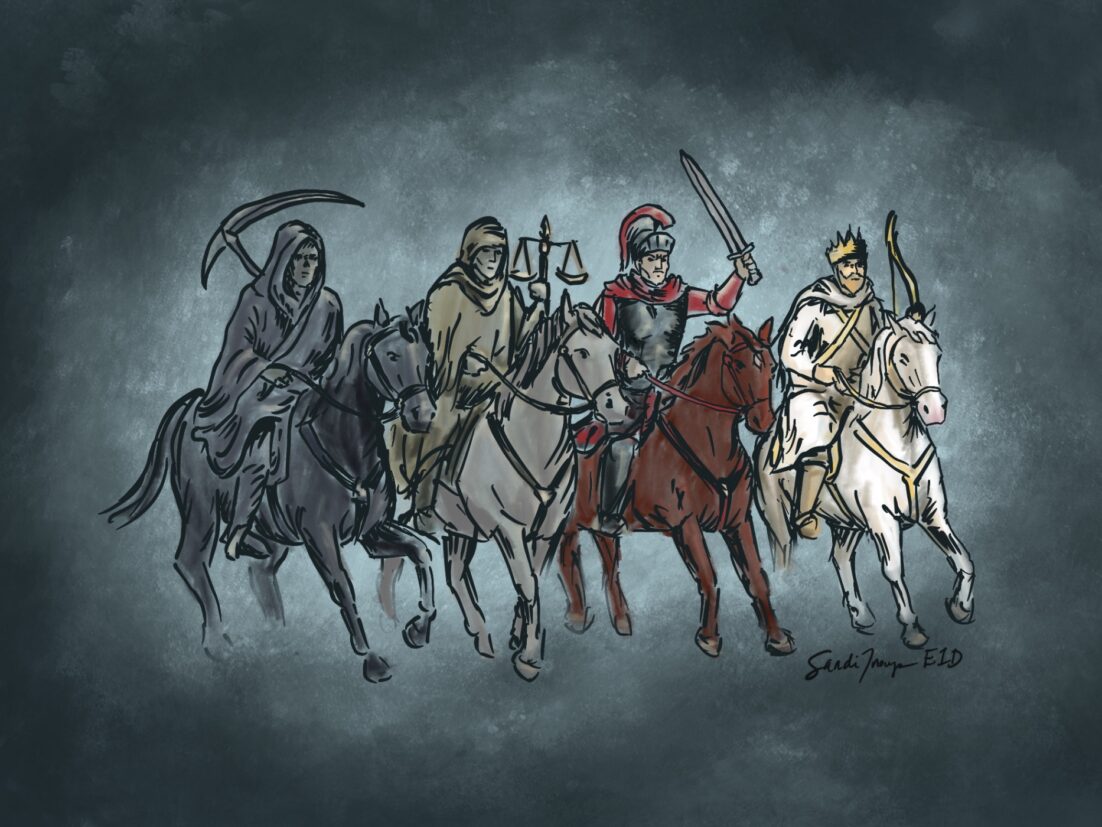
The Four Horsemen of the Apocalypse are often treated as distant, frightening symbols of the end times. But what if they were never meant to be distant?
In this episode of Everyone Dies, we take a grounded, thoughtful look at what Conquest, War, Famine, and Death represent—and why they matter right now. From global conflict and food insecurity to health crises and the absolute certainty of mortality, these ancient images continue to mirror modern life.
But this isn’t a conversation about fear. By naming these struggles, we strip away their power, allowing us to live with greater intention, care deeply for one another, and remember that even in uncertain times, every single day is a gift.
- Comfort in the Darkness: A delicious recipe for Devils on Horseback and a beautiful reading from Anne Lamott on holding back the dark through radical self-love and practical gratitude.
- The Four Horsemen Unsealed: A deep dive into the historical, biblical, and artistic legacy of the riders from the Book of Revelation, and how their themes connect directly to our current societal struggles.
- The Weight of Choice: A striking reading from Ayn Rand’s Atlas Shrugged on personal responsibility, absolutes, and the danger of compromising with evil.
Timestamps:
- 00:00 – Intro – Continuing our humanities series on death with the modern reality of the Four Horsemen
- 03:37 – Recipe of the Week: Devils on Horseback – Charlie shares a salty-sweet comfort food perfect for a funeral lunch
- 04:12 – Getting Our Joy Back (Anne Lamott) – Charlie reads a piece on holding back the darkness, practicing radical self-love, and finding gratitude
- 07:18 – The Symbolism of the Four Horsemen – Marianne explores the historical and symbolic roots of the riders
- 09:03 – The Four Horsemen in the Bible – A look at the opening of the first four seals in the Book of Revelation
- 12:38 – How The Four Horsemen Resonate in Literature and Art – We explore apocalyptic themes in creative works like Cormac McCarthy’s The Road
- 14:17 – Themes in the World Around Us – Connecting the ancient symbols of the riders to modern-day societal struggles, health crises, and global events
- 17:14 – From Ayn Rand, in Atlas Shrugged – Charlie reads the excerpt on absolutes, personal responsibility, and refusing to compromise with evil)
- 19:25 – Outro – Every Day is a Gift
Symbols of the Human Experience: Recognizing the Four Horsemen in Our Daily Lives
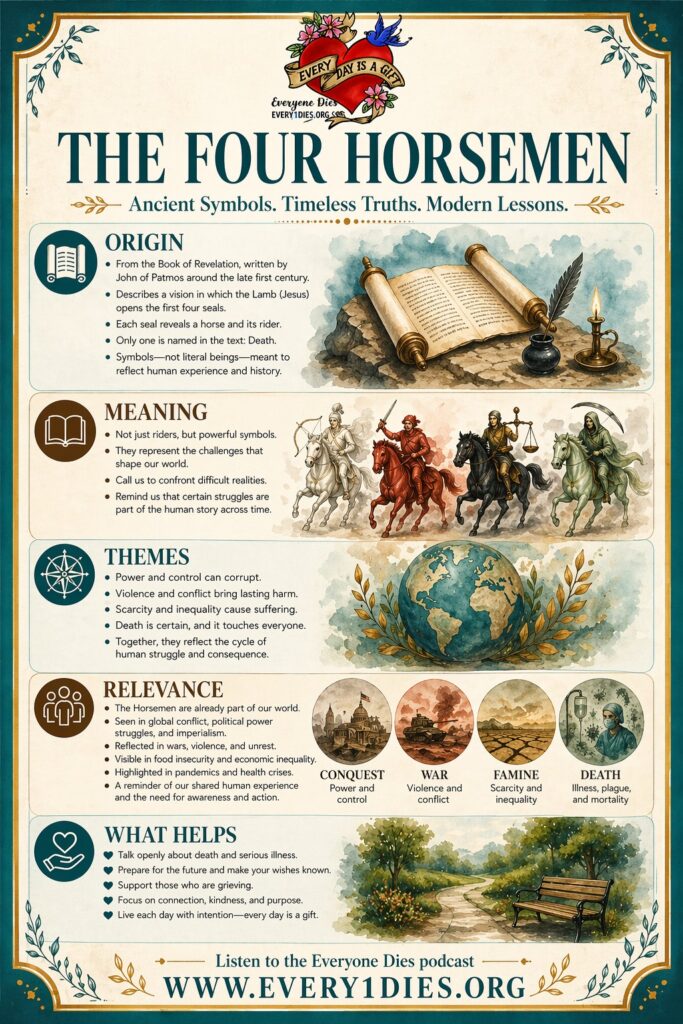
The Four Horsemen of the Apocalypse are often described strictly as terrifying signs of the end of the world. Originating from the vivid, symbolic imagery of the Book of Revelation, these figures can easily feel distant, dramatic, and entirely disconnected from our everyday reality.
But the riders known as Conquest, War, Famine, and Death are not just predictions about a future catastrophe. They are enduring symbols of the universal human experience. Across centuries, they have represented the heavy forces that disrupt lives, destabilize societies, and challenge our collective sense of peace.
More Than a Future Catastrophe: The Certainty of Mortality
While three of the riders describe external conditions we may encounter—power struggles, violence, and economic scarcity—the final rider, Death, is something we all personally share. In the biblical text, Death is the only rider explicitly named. This distinction matters. For humanity, mortality is not a distant possibility; it is an absolute certainty.
When we look at the world today, the symbolism becomes difficult to ignore. Geopolitical conflict continues to displace communities, food insecurity impacts millions, and global health crises have fundamentally reshaped how we live and relate to one another. These are not abstract concepts. They are lived, modern realities.
The Power of Naming Our Fears
Acknowledging that the Four Horsemen are already here does not mean we are living in the end times. Rather, it means recognizing that the human journey has always included struggle, uncertainty, and loss.
There is immense power in simply naming these heavy realities. When we avoid conversations about death and hardship, our cultural fear only grows. But when we openly acknowledge them, something shifts. We become better prepared. We find the courage to talk honestly about serious illness, to define the choices we would want for our own care, and to show up more deeply for those who are grieving.
“The riders known as Conquest, War, Famine, and Death are not just predictions about a future catastrophe. They are enduring symbols of the universal human experience.”
Choosing How We Respond
In this light, these ancient symbols cease to be a source of terror and instead become a profound reminder that our time is limited, our relationships matter, and the conversations we put off are often the ones carrying the most weight.
Understanding the Horsemen doesn’t change the difficult realities they represent, but it completely changes how we choose to respond to them. In the face of overwhelming darkness, we can choose to shine a little brighter—practicing the radical self-love, active gratitude, and mutual care required to navigate tough times with strength and hope. It reminds us, in a beautifully clear way, that we do not have to live unprepared, and that every single day we have is a gift.
References:
- RECIPE of the Week: Devils on Horseback – sweet dates, smoky almonds, and crispy bacon in each bite
- “Getting our ‘Joice Back” by Anne Lammott
- Atlas Shrugged by Ayn Rand
- What Do the Four Horsemen of the Apocalypse Symbolize and Their Impact on Modern Society
Resources:
- The Road by Cormac McCarthy
- The Conversation Project: Helping people share their wishes for care through the end of life.
- Option B: Facing Adversity, Building Resilience, and Finding Joy by by Sheryl Sandberg and Adam Grant
Everyone Dies: and yes, it is normal!
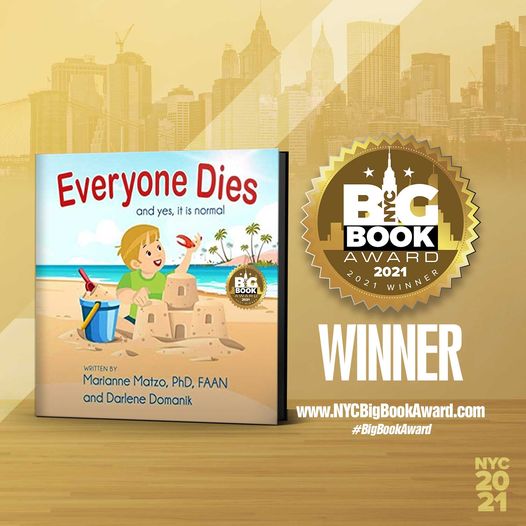
Everyone Dies (and yes, it is normal) is a story about a young boy named Jax who finds something special on the beach where he and his grandpa Pops are enjoying a wonderful day. Pops helps Jax understand that death is a normal part of life. This book provides an age appropriate, non-scary, comfortable way to introduce the important topic of mortality to a preschool child. Its simple explanation will last a lifetime. Autographed copies for sale at: www.everyonediesthebook.com. Also available at Amazon
Mourning Jewelry

We offer a way to memorialize your loved one or treasured pet with a piece of handmade jewelry. When people comment on it and the wearer can say for example “I received this when my mother died” which opens the conversation about this loss. All our jewelry is made with semi-precious stones and beads, vintage beads, and pearls. You can choose between earrings or bracelets and the color family. Learn More
Make a Tax-Deductible Donation Here:
Subscribe & Hit That Bell So You Don’t Miss a Podcast!

Use the Feedspot RSS reader to find more.