


Learn How to Deal with Grief, Restore Daily Purpose, and Reconnect with Life
When someone you love dies, you don’t just lose their presence. You can also lose your daily routines, your roles, your future plans, and even your reason to get out of bed in the morning. That can leave a heavy question behind: What gives my life meaning now?
This week we explore how two powerful concepts—the Japanese framework of ikigai (your reason for living) and the psychology of flow—can help you begin rebuilding purpose after loss.
Finding meaning doesn’t require “moving on” or forgetting the person who died. It’s about discovering how grief and a fulfilling life can gradually exist together.
Episode Timestamps:
- 00:00 – Intro: Finding Meaning and Purpose After Loss
- 01:30 – Recipe of the Week: Ikigai Dumplings
- 03:30 – 11 Rules for Aging and Living Fully: Roger Rosenblatt’s NYT Essay
- 09:30 – When Grief Disrupts Purpose: Understanding Loss and Identity
- 11:09 – What Is Ikigai and Flow? Psychology Tools for Grief Recovery
- 13:58 – 4 Practical Steps to Reconnect with Life and Joy
- 22:02 – “Delicious Ambiguity”: Embracing Uncertainty with Gilda Radner
- 22:35 – Closing/Outro with words from actress Norma Shearer
When Grief Takes Away Your Sense of Purpose: Finding Meaning After Loss
How Grief Disrupts Identity and Purpose
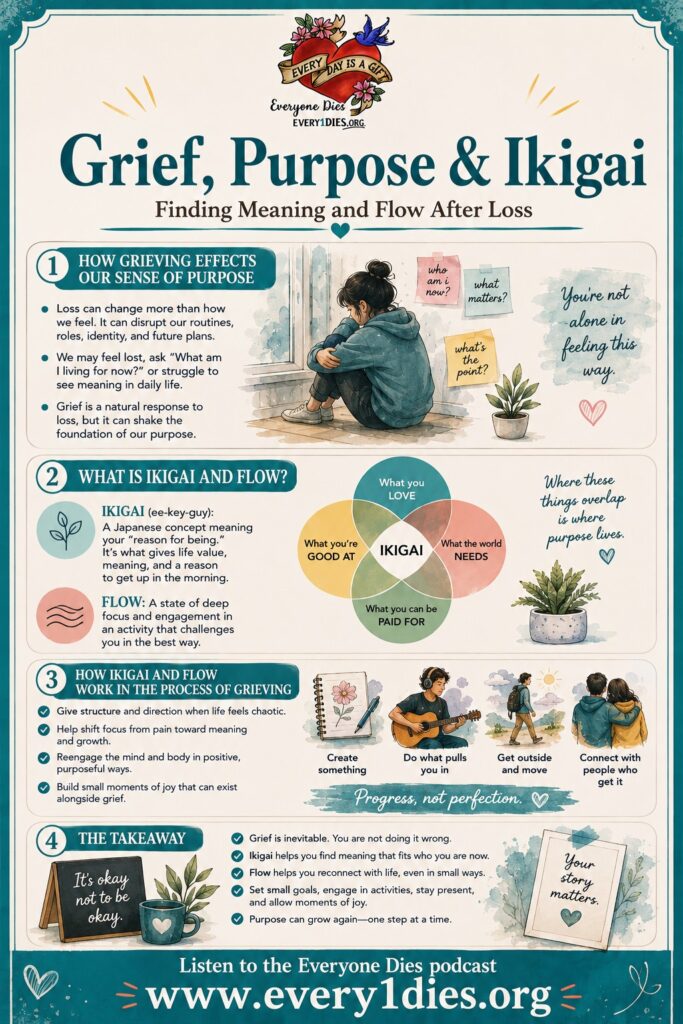
Grief is a natural response to death or losing something important to us. Although sadness is one of its most recognizable features, grief can affect us much more than our emotions. Loss can change our relationships, daily routines, responsibilities, beliefs, identity, and expectations for the future. For some people, one of the most difficult consequences is the loss of a sense of purpose. The things that once gave structure and meaning to daily life may no longer exist in the same way.
A person who spends years caring for a spouse may suddenly wake up without someone who needs their care. A parent may struggle with an identity profoundly connected to a child who has died. A person living with serious illness may grieve the loss of independence, physical abilities, work, or plans. The question becomes not simply, “How do I stop grieving?” but “How do I live meaningfully now?”
Grief Can Disrupt Our Understanding of Life
Our relationships help organize our lives. They influence what we do, how we spend our time, how we understand ourselves, and what we expect from the future. When an important relationship ends through death, those assumptions can be disrupted.
Bereaved people may find themselves trying to understand how the death fits into the story of their lives. They may reconsider beliefs, priorities, relationships, and their understanding of themselves. Some people also experience questions about spirituality or faith.
This search for meaning is not necessarily an attempt to find a reason why the person died. Some deaths will never seem reasonable or acceptable. Instead, meaning-making can involve finding a way to incorporate the reality of the loss into one’s life while determining how to continue living.
Finding Meaning Does Not Mean Leaving Someone Behind
People are sometimes concerned that adapting to grief means forgetting the person who died or “moving on.” That is not the goal. A meaningful life after bereavement can continue to include the person who died. We may tell their stories, maintain traditions, support causes that mattered to them, remember their advice, or incorporate what we learned from the relationship into the way we live. The relationship has changed, but its significance does not have to disappear.
What Is Ikigai and Flow State in Grief Recovery?
One framework for thinking about purpose is the Japanese concept of ikigai.
The term is commonly associated with what makes life worthwhile or gives someone a reason for living. Importantly, a sense of purpose does not have to involve an extraordinary achievement.
Purpose can be found in relationships, work, creativity, learning, caregiving, nature, community involvement, spirituality, hobbies, or seemingly ordinary daily activities. After a significant loss, some of the things that previously provided purpose may no longer be available. Part of adapting to grief can therefore involve discovering what provides meaning now, which That be different from what it was before their death.
Grief and the Experience of Flow
Another useful concept comes from psychologist Mihaly Csikszentmihalyi’s work on flow. Flow describes periods of deep involvement in an activity during which attention becomes highly focused. People can experience flow through many activities, including art, music, exercise, gardening, writing, woodworking, cooking, learning, or other tasks that provide an appropriate balance between challenge and ability.
For someone who is grieving, engaging in an absorbing activity does not erase grief. It can, however, provide periods in which attention is directed toward something meaningful and manageable. Over time, these experiences may become part of reconnecting with life.
Four Ways to Begin Reconnecting with Purpose
4 Practical Steps to Reconnecting with Life:
1. Set Small, Meaningful Goals
2. Immerse Yourself in Activity
3. Look Outward
4. Allow Yourself Enjoyment

The first step is to identify a meaningful goal. It does not have to be large. The important question is whether the goal matters enough to deserve some of your attention and energy.
The second is to become involved in an activity. Look for something that requires enough concentration to hold your attention. This might be exercise, art, gardening, volunteering, learning something new, or completing a project.
The third is to pay attention to the world outside yourself. Grief naturally draws attention toward the person who died and toward our own pain. Maintaining relationships, noticing our surroundings, and participating in activities can gradually expand our attention again.
The fourth is to allow yourself to experience enjoyment.
This can be particularly difficult. A grieving person may laugh at something and immediately feel guilty. They may enjoy an afternoon with friends and wonder how they could possibly have had a good time when someone they love is dead.
Experiencing pleasure does not diminish the importance of the person who died. Grief and joy are not mutually exclusive.
You Do Not “Get Over” Grief
The goal of healthy grieving is not to eliminate every reminder of the person or return to exactly who you were before the death. Losses change us; over time it may become possible to carry the loss while also experiencing relationships, interests, accomplishments, laughter, curiosity, and purpose. Finding meaning does not require deciding that the loss happened for a reason. It does not require gratitude for suffering, and it does not require forgetting.
It means gradually answering a different question: Given what has happened, what matters to me now? That answer may begin very small. Sometimes rebuilding a meaningful life begins not with discovering one enormous purpose, but with finding one reason to get up tomorrow morning.
Related Content:

- S6E16 — Goals After Grief: Gentle, Practical Steps to Move Forward After Loss – A companion discussion offering seven manageable tips for navigating loss, establishing daily direction, and gently rebuilding a life you can bear again
- How Creative Expression Can Help You Live With Grief – When grief is too big for words, hands-on creation can offer an anchor. Discover how engaging in art, writing, crafts, or musical projects provides an absorbing outlet to process raw emotion and carry loss.
- What’s in Your Library? Building Grounding Resources through a Practice of Mindfulness – Cultivating presence in everyday moments helps calm a overwhelmed nervous system. Learn how to build a personalized sensory “library” of grounding experiences to help you stay present through heavy waves of sorrow.
- S6E34 — Surviving the Waves: Tips on How to Live Alongside Grief – When sorrow hits like a tsunami, learning how to stay afloat is key. This episode shares practical strategies for navigating grief bursts and living alongside loss without losing your footing.
- Coping Forward: Mental Health Strategies After Major Loss – Adapting to loss isn’t about “getting over it” or forcing closure. Explore practical mental health strategies for adjusting to a altered world while honoring your ongoing bond with the person who died.
Recipe of the Week: Oyaki Steamed Dumpling Delight With Sweet or Savory Fillings
References:
- How to Be Old Roger Rosenblatt, Guest Essay, New York Times
- The Philosophy of Ikigai: 3 Examples About Finding Purpose
- What is your Ikigai?
- Csikszentmihalyi, M. (1990). Flow: The Psychology of Optimal Experience. Harper & Row, Publishers, New York.
- Neimeyer, R. A., Prigerson, H. G., & Davies, B. (2002). Mourning and meaning: PROD. The American Behavioral Scientist, 46(2), 235-251. https://doi.org/10.1177/000276402236676
- Thakur, J. D., Patiballa, S. K., Patel, J. M., Setya, N., Paudel, P., Patel, A., Hummel, U. N., & Khaleghi, M. (2026). Grief in the circle of neurosurgery: observing through the lens of science, spirituality, and philosophy. Neurosurgical focus, 61(2), E12. https://doi.org/10.3171/2026.5.FOCUS26175 Full Text
Resources:
- Ikigai: The Japanese Secret to a Long and Happy Life
- by Héctor García, Francesc Miralles Available Here: https://a.co/d/0j9CD8UN
- How to Find Joy in Your Everyday Life (Even When Life Feels Awful) https://www.prevention.com/health/mental-health/g33002023/how-to-find-joy/
- 28 Great Ways To Find Joy In Your Everyday Life https://www.aconsciousrethink.com/16930/how-to-find-joy-in-life/
- Reasons to Get Out of Bed and Be Grateful Even When You’re Bored and Lonely https://www.bolde.com/reasons-to-get-out-of-bed-and-be-grateful-even-when-youre-bored-and-lonely/

Use the Feedspot RSS reader to find more.

Everyone Dies: and yes, it is normal!

Everyone Dies (and yes, it is normal) is a story about a young boy named Jax who finds something special on the beach where he and his grandpa Pops are enjoying a wonderful day. Pops helps Jax understand that death is a normal part of life. This book provides an age appropriate, non-scary, comfortable way to introduce the important topic of mortality to a preschool child. Its simple explanation will last a lifetime. Autographed copies for sale at: www.everyonediesthebook.com. Also available at Amazon
Mourning Jewelry

We offer a way to memorialize your loved one or treasured pet with a piece of handmade jewelry. When people comment on it and the wearer can say for example “I received this when my mother died” which opens the conversation about this loss. All our jewelry is made with semi-precious stones and beads, vintage beads, and pearls. You can choose between earrings or bracelets and the color family. Learn More