


Sir Patrick Stewart’s recent passing from Alzheimer’s disease and Lewy body dementia highlights how complex overlapping neurological conditions can be. Memory loss, resting tremors, and visual hallucinations can point to different neurological conditions. In this episode, we unpack why the order in which symptoms appear holds the key to distinguishing Alzheimer’s disease, Lewy body dementia, and Parkinson’s disease.
In this Episode:
- 00:00 – Intro: Alzheimer’s, Lewy Body Dementia (LBD), or Parkinson’s: How to Tell the Difference
- 06:58 – In Memoriam: Sir Patrick Stewart’s Legacy & Essay on Domestic Violence
- 13:21 – Is It Alzheimer’s, Parkinson’s, or Lewy Body Dementia?
- 14:48 – Protein Pathology: Amyloid, Tau, and Alpha-Synuclein Alter Brain Function
- 17:11 – Symptom Clues: Distinguishing Memory Loss, Visual Hallucinations, and Motor Tremors
- 26:51 – The Clinical “One-Year Rule” & Robin Williams’ LBD Pathology
- 36:56 – “Sea-Fever” by John Masefield
- 38:42 – Closing Remarks
Alzheimer’s, Lewy Body Dementia, or Parkinson’s Disease: How Can You Tell the Difference?
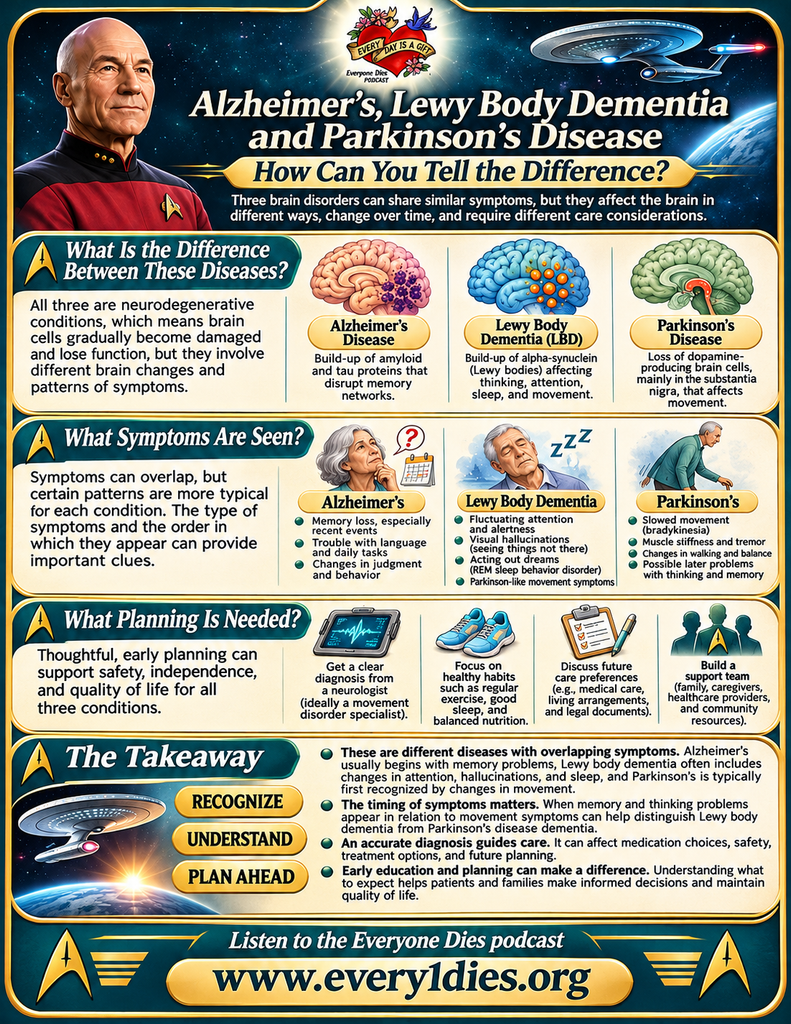
Alzheimer’s disease, Lewy body dementia, and Parkinson’s disease are neurological conditions that become more common with age. Although they are different diseases, they can share symptoms involving memory, thinking, movement, sleep, and behavior. Understanding their differences can help patients and families recognize changes and seek appropriate medical evaluation.
Alzheimer’s Disease: Memory Problems Often Come First
Alzheimer’s disease most commonly begins with difficulty remembering recently learned information. A person may repeat questions, forget conversations, or have trouble keeping track of appointments and medications. As the disease progresses, problems with language, judgment, orientation, and daily activities may become more noticeable.
Alzheimer’s is associated with abnormal accumulation of amyloid-beta and tau proteins in the brain. These changes damage nerve cells and interfere with the brain’s ability to process and store information. Although memory loss is the most familiar early symptom, some people initially experience changes in language or visual processing.
Lewy Body Dementia: Changes in Attention, Hallucinations, and Sleep
Dementia with Lewy bodies often causes difficulties with attention, visual perception, and thinking. A person may be alert and engaged at one time but unusually confused or drowsy later, and some people experience detailed visual hallucinations. Acting out dreams during sleep, known as REM sleep behavior disorder, may also occur years before other symptoms.
Lewy body dementia is associated with abnormal deposits of a protein called alpha-synuclein. These changes can affect thinking, movement, sleep, and automatic body functions such as blood pressure regulation. People with this condition may also develop stiffness, slowed movement, and walking difficulties like those seen in Parkinson’s disease.
Parkinson’s Disease: Movement Problems Usually Lead to Diagnosis
Parkinson’s disease is usually recognized through changes in movement, including slowed movements, muscle stiffness, resting tremors, and walking difficulties. Symptoms often begin on one side of the body and gradually affect both sides. Constipation, reduced sense of smell, sleep disturbances, and mood changes may appear before movement problems become obvious.
Parkinson’s disease involves the loss of dopamine-producing nerve cells in the brain. Although some people eventually develop cognitive impairment or dementia, dementia is not inevitable. Many people live for years with Parkinson’s disease before experiencing significant problems with thinking or memory.
| Characteristics | Alzheimer’s Disease | Dementia with Lewy Bodies | Parkinson’s Disease |
|---|---|---|---|
| Primary Pathology | Amyloid-beta and tau | Alpha-synuclein | Alpha-synuclein and loss of dopamine-producing neurons |
| Typical Early Presentation | Recent memory problems | Fluctuating attention, visual-perceptual problems, sometimes hallucinations | Slowness, stiffness, resting tremor |
| Memory Impairment | More common in later stages | Often appear early | May occur, particularly with cognitive decline or medication effects |
| Dementia | Defining feature once Alzheimer’s reaches the dementia stage | Required for a DLB diagnosis | Not inevitable; may develop later |
| Thinking Variabilities | Can occur | Particularly characteristic | May occur with cognitive impairment |
| Movement Difficulties | Usually later | May occur early | Central feature |
| Acting Out Dreams | Possible | Characteristic feature | Can precede motor symptoms |
| Visual Hallucinations | More common in later stages | Often appear early | May occur, particularly with cognitive decline or medication effects |
Why the Timing of Symptoms Matters
Dementia with Lewy bodies and Parkinson’s disease dementia are closely related conditions. Clinicians commonly use the one-year rule, which considers whether dementia begins before, around the same time as, or within one year of Parkinson-like movement symptoms. When dementia develops after more than a year of established Parkinson’s disease, the diagnosis is generally Parkinson’s disease dementia.
This distinction is useful for clinical classification, although the underlying diseases overlap considerably. The timing of symptoms is only one part of a comprehensive evaluation. Neurological examinations, cognitive testing, medical history, and sometimes specialized imaging or biomarkers help clinicians determine the most likely diagnosis.
Why an Accurate Diagnosis Matters for Dementia
An accurate diagnosis helps healthcare professionals choose appropriate treatments and avoid medications that may cause serious side effects. For example, people with dementia with Lewy bodies may be particularly sensitive to certain antipsychotic medications. Understanding the diagnosis also helps families anticipate changes in mobility, cognition, independence, and caregiving needs.
Although there is currently no cure for these conditions, medications, rehabilitation, supportive care, and advance planning can improve quality of life. Patients and families benefit from discussing symptoms, treatment options, safety, and future healthcare preferences with their clinical team. Early conversations can help ensure that care remains consistent with the person’s needs and values.
Frequently Asked Questions
Why is an accurate diagnosis important for dementia medications?
People with Dementia with Lewy Bodies often experience severe, life-threatening sensitivities to certain antipsychotic medications. Proper classification ensures clinicians select safe therapies that avoid worsening muscle stiffness or confusion.
Can a person have both Alzheimer’s and Lewy Body Dementia?
Yes, mixed pathology is common in older adults. A person can exhibit both amyloid/tau changes and alpha-synuclein deposits simultaneously, as was reported following Sir Patrick Stewart’s passing.
What is REM sleep behavior disorder?
REM sleep behavior disorder occurs when normal muscle paralysis during sleep is absent, causing a person to punch, kick, or shout while acting out dreams. This behavior can precede Lewy body disorders by many years.
Related Episodes About Dementia:
- S1E48: Alzheimer’s Disease
- S2E1: Lewy Body Disease
- S2E2: Parkinson’s Disease
- S3E50: Caring for a Partner with Dementia
References:
- Recipe: Canape plate: Ailis pate, Felada onion crisp and stuffed Cardaway leaves
- Patrick Stewart: the legacy of domestic violence | Domestic violence | The Guardian
- Patrick Stewart, ‘Star Trek’ Captain and Professor X on ‘X-Men,’ Dies at 86 – The New York Times
- Sea-Fever | The Poetry Foundation
- The terrorist inside my husband’s brain | Neurology
Resources:
- LBD Diagnosis & Assessment | Lewy Body Dementia Association (LBDA)
- Lewy body dementia – Diagnosis and treatment – Mayo Clinic
- Lewy Body Dementia: Causes, Symptoms, and Diagnosis | National Institute on Aging
- A Present You Can Hear, Forever Cherished: Luxury recordable time capsule that preserves your words, your presence, your memory and your emotions across lifetimes. https://www.amarantomoments.com/ email: hello@amarantomoments.com

Use the Feedspot RSS reader to find more.

Everyone Dies: and yes, it is normal!

Everyone Dies (and yes, it is normal) is a story about a young boy named Jax who finds something special on the beach where he and his grandpa Pops are enjoying a wonderful day. Pops helps Jax understand that death is a normal part of life. This book provides an age appropriate, non-scary, comfortable way to introduce the important topic of mortality to a preschool child. Its simple explanation will last a lifetime. Autographed copies for sale at: www.everyonediesthebook.com. Also available at Amazon
Mourning Jewelry

We offer a way to memorialize your loved one or treasured pet with a piece of handmade jewelry. When people comment on it and the wearer can say for example “I received this when my mother died” which opens the conversation about this loss. All our jewelry is made with semi-precious stones and beads, vintage beads, and pearls. You can choose between earrings or bracelets and the color family. Learn More