


Learn how dogs and cats grieve after losing a loved one, signs of pet grief to watch for, and when behavioral changes mean it’s time to call your vet.
In this Episode:
- 00:00 – Intro: Do Dogs and Cats Grieve? Helping Pets Through Loss
- 01:44 – Personal Stories: Navigating Loss and Animal Companions
- 06:05 – Recipe of the Week: Ultimate Olympic Sausage Balls
- 06:37 – Brain Scans & Dog Emotions: What Research Shows
- 12:25 – What Pet Grief Looks Like (And the Grief vs. Illness Red Flags)
- 18:37 – Emotional Contagion & How to Prepare a Pet Profile Sheet
- 24:56 – 7 Practical Ways to Support Your Grieving Pet
- 29:26 – Outro
Can dogs and cats grieve when someone they love dies?
Research shows that pets experience noticeable behavioral shifts after losing an animal companion or human family member. But recognizing grief in animals—and knowing how to help—isn’t always straightforward.
In this episode of Everyone Dies, we break down:
- The Behavioral Signs: How grief shows up in dogs and cats through changes in appetite, sleep, vocalizations, search habits, and affection (why some pets turn clingy while others withdraw).
- The “Grief vs. Illness” Red Flag: Why hiding, lethargy, and skipped meals can signal a medical emergency rather than just grief, and exact thresholds for when to call your vet.
- Emotional Contagion: How a surviving pet absorbs human distress, and why stabilizing your own routine directly helps your animal heal.
- Navigating Primary Caregiver Loss: Key documentation strategies (feeding schedules, medication, triggers, and quirks) to ensure a smooth transition if a pet must move to a new home or caregiver.
Grief impacts every living creature in the home. Tune in to learn how to read your pet’s subtle cues, keep their world predictable, and support them through the loss.
How Dogs and Cats Grieve a Death in the Family, and What Actually Helps
by Mia Price
Your dog is waiting at the door at 5:40 every evening, the exact time the person who used to walk through it stopped coming home. Your cat has stopped eating from the bowl on the left and started sleeping in a closet that was never hers. This is what grief tends to look like in an animal. It’s also landing in a household that needs steady hands right now, even though yours are already full.
What Grief Looks Like in a Dog or Cat
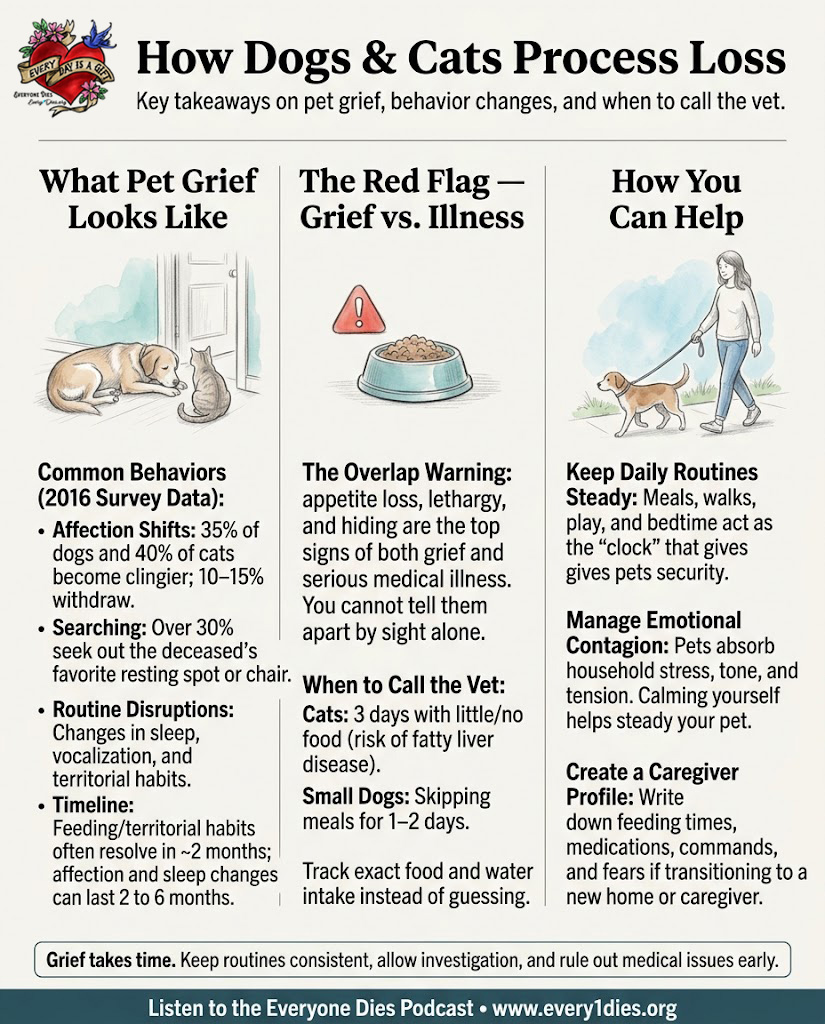
A 2016 survey of 279 owners in Australia and New Zealand, covering 159 dogs and 152 cats, published in the journal Animals, found that after the loss of a companion animal in the household, 74% of dogs and 78% of cats changed how they sought affection. Most of that moved one direction: 35% of dogs and 40% of cats became more demanding of attention, and 26% of dogs and 22% of cats turned clingy in ways they weren’t before. But 10% of dogs and 15% of cats went the other way and wanted less contact than they used to, which is worth knowing if your animal has gone quiet and you’ve been reading that as coping. Sixty percent of dogs and 63% of cats changed territorial behavior, and within that group, 30% of dogs and 36% of cats sought out the favorite resting spot of the animal that died. That study measured the loss of another pet, not a person, but veterinarians and welfare organizations describe the same pattern clinically when a human in the household dies: appetite changes, searching behavior, altered vocalization, disrupted sleep.
The timing has a rough shape to it. Feeding and territorial changes tend to resolve within about two months. Affection-seeking and sleep disruption can run two to six months before settling. VCA Animal Hospitals notes that roughly 30% of pets show decreased appetite after losing a companion, and that predictable mealtime, exercise, and bedtime routines help pets feel more secure during that stretch. For an animal, those times are the clock. None of this resolves on a fixed schedule. Some animals are visibly different for a week. Some are still checking the door in month four.
Let the animal investigate the absence rather than managing it away from them. Dogs and cats process a lot through scent and searching, and blocking off the person’s closet or hiding their chair does not spare the animal confusion. It just removes information the animal was already looking for.
Grief or a Medical Problem? The Two Look Identical
Here is the complication nobody wants at week two: appetite loss, lethargy, and hiding are the first three signs of both grief and serious illness, and you cannot tell them apart by looking. A grieving cat and a sick cat behave almost identically from across the room.
There is a concrete deadline here, not a feeling. Cats can develop hepatic lipidosis, a fatty liver condition, after roughly three to four consecutive days of not eating, and it becomes life-threatening if untreated. That is the threshold: if a cat has gone three days with little to no food, or a small dog has skipped more than a day or two, call the veterinarian rather than waiting to see if grief passes on its own. Track actual food and water intake rather than your impression of it. Note how much goes into the bowl, how much is still sitting there an hour later, and whether the water level is dropping at all. Grief does not typically produce a total refusal to eat for days on end. If it does, treat it as a medical question first.
Your Steadiness Is Part of Their Care Plan
This part surprises people. A 2022 study surveying 426 Italian dog owners whose surviving dog had lost a companion, published in Scientific Reports, found that a reduction in the surviving dog’s food intake was significantly more likely when the owner was also grieving, and that the surviving dog’s fearfulness tracked with the owner’s own reported grief and psychological distress. The researchers describe this as a form of emotional contagion: a distressed household transmits stress to the animal in it, through tone of voice, tension, and disrupted routine, independent of whatever the animal itself is processing. Those same authors are careful to say they can’t confirm what they measured was grief, and that caution is worth carrying with you. What’s documented is a behavior change in the animal that tracks with the state of the person caring for it.
That does not mean you have to perform composure you do not feel. It means the work of steadying your own body, slower breathing, a predictable voice, keeping your own eating and sleeping on some kind of track, is not separate from the animal’s recovery. It is one of the more direct things you can do for a dog or cat that cannot be handed a grief pamphlet. The American Veterinary Medical Association frames human grief around six components: acknowledging the loss, working through the emotions instead of suppressing them, preserving memory, adjusting identity, finding meaning, and accepting support. Any caregiver doing that work for themselves is, indirectly, doing it for the animal too.
Keep exercise and outdoor time going even on the days you would rather not leave the house. A tired dog and a mentally engaged cat both handle disruption better than a bored one, and a walk at the usual time keeps one more hand on that clock where it belongs.
Building the One Page Profile
The hardest version of this arrives when the person who died was the animal’s only caregiver, and now the family is arranging a new home for the dog or cat in the same week as a funeral. Nobody in that position has bandwidth to explain a routine from memory to a stranger, so it needs to be written down. A one page profile does that work. It should cover:
- Feeding: Brand, amount, schedule, any food the animal refuses
- Medications: Name and administration time, prescribing vet’s contact info
- Commands and training: Words or hand signals the animal already responds to
- Fears and triggers: Storms, men in hats, the vacuum, whatever it is
- Quirks: Sleeping spots, favorite toy, how it likes to be greeted
- Routine: Walk times, crate habits, who else it’s used to living with
Ask anyone who fosters and you’ll hear some version of the same story. A dog arrives with a leash and a name, and the next three weeks go to re-learning by trial and error what the previous owner already knew. That she won’t eat near other dogs. That she settles if the hallway light stays on. That “off” means something different to her than “down.” Hill’s Pet’s guidance on rehoming a dog after a death recommends carrying over the same leash, bowls, and feeding times whenever possible, precisely the details a one page profile preserves. A page of notes saves those three weeks. Adobe Express has a free resume creator that will give you a clean one page layout without fighting a word processor’s margins in a week when nobody has patience left for formatting. It’s built for a different kind of document, but the fields don’t care what you put in them, and rescues, fosters, and adopters ask for this information anyway.
Tip: Download the above file to your computer before filling for the multi-line fields to behave properly.
Keep that same page even if the animal is staying in the family and simply moving in with a sibling or adult child. If a surviving spouse ends up downsizing into a rental with a pet policy, the landlord will ask for close to the same document: proof of routine, vaccination status, behavior history. Having it ready removes one more thing to assemble under pressure.
What This Doesn’t Resolve
There’s no clean timeline to hand you here, and no promise that the dog checking the door will stop by a certain week. Some animals settle in under two months. Some take the better part of a year, and a few carry a changed habit permanently: a cat that never goes back to sleeping on the bed, a dog that stays a little more watchful at the sound of a car in the driveway. Watch the concrete things: food, water, weight, sleep, and whether the animal is still willing to be touched. Keep the routine as steady as you can manage while your own routine is anything but. And if something crosses from unfamiliar into alarming, especially around eating, don’t wait it out to see if it’s just grief. Call the vet, then keep going.
Listen to the podcast to learn about what the science says about pet grief through dog brain MRIs and also Seven Practical Ways to Support a Grieving Pet.
Related Content:
- Meet Dimple Rose
- S2E10: Planning a Memorial Ceremony for Your Pet
- S3E1: What you can do to help a grieving pet
References:
Recipe of the Week: Ultimate Sausage Balls
- Walker, J. K., Waran, N. K., & Phillips, C. J. (2016). Owners’ Perceptions of Their Animal’s Behavioural Response to the Loss of an Animal Companion. Animals : an open access journal from MDPI, 6(11), 68. https://doi.org/10.3390/ani6110068
- Uccheddu, S., Ronconi, L., Albertini, M., Coren, S., Da Graça Pereira, G., De Cataldo, L., Haverbeke, A., Mills, D. S., Pierantoni, L., Riemer, S., Testoni, I., & Pirrone, F. (2022). Domestic dogs (Canis familiaris) grieve over the loss of a conspecific. Scientific reports, 12(1), 1920. https://doi.org/10.1038/s41598-022-05669-y
- Hernández-Pérez, R., Concha, L., Andics, A., Bernal-Gamboa, R., & Cuaya, L. V. (2026). Dog brain representations of human facial expressions: Encoding happiness and differentiating specific negative expressions. iScience, 29(8). https://doi.org/10.1016/j.isci.2026.116900
- Helping Your Grieving Pet https://vcahospitals.com/know-your-pet/helping-your-grieving-pet
- Scientists Gave Dogs MRIs and Learned That They’re Surprisingly Good at Distinguishing Between Human Emotions, Even Some Negative Ones: https://www.smithsonianmag.com/smart-news/scientists-gave-dogs-mris-and-learned-that-theyre-surprisingly-good-at-distinguishing-between-human-emotions-even-some-negative-ones-180989329/
Resources:
- Mia Price: https://spiritpup.com/
- Helping Your Grieving Pet https://vcahospitals.com/know-your-pet/helping-your-grieving-pet
- Hepatic Lipidosis in Cats (Fatty Liver Syndrome in Cats) https://vcahospitals.com/know-your-pet/liver-disease-fatty-liver-syndrome-in-cats
- Coping with the loss of a pet: https://www.avma.org/resources-tools/pet-owners/petcare/coping-loss-pet
- Rehoming a Dog After the Loss of a Loved One: https://www.hillspet.com/dog-care/new-pet-parent/rehoming-a-dog-after-loved-one-passes

Use the Feedspot RSS reader to find more.

Everyone Dies: and yes, it is normal!

Everyone Dies (and yes, it is normal) is a story about a young boy named Jax who finds something special on the beach where he and his grandpa Pops are enjoying a wonderful day. Pops helps Jax understand that death is a normal part of life. This book provides an age appropriate, non-scary, comfortable way to introduce the important topic of mortality to a preschool child. Its simple explanation will last a lifetime. Autographed copies for sale at: www.everyonediesthebook.com. Also available at Amazon
Mourning Jewelry

We offer a way to memorialize your loved one or treasured pet with a piece of handmade jewelry. When people comment on it and the wearer can say for example “I received this when my mother died” which opens the conversation about this loss. All our jewelry is made with semi-precious stones and beads, vintage beads, and pearls. You can choose between earrings or bracelets and the color family. Learn More