


Peace of Mind, Legal Safeguards, and Treasuring Every Day at the End of Life
Medical aid in dying (MAiD) is legal in a growing number of U.S. jurisdictions, yet misconceptions about how it works remain widespread. Explore who qualifies under strict legal safeguards, why the patient must initiate and self-administer the medication, why roughly one-third of patients never use their prescription, and how MAiD coexists alongside hospice care.
In This Episode:
- 00:00 – Intro: Peace of Mind at the End of Life—Choice, Safeguards, and Control
- 02:25 – Recipe of the Week: Giant Vermont Grilled Cheese Appetizer
- 02:57 – Living Now & Fighting with Dignity: Eric Dane’s “Famous Last Words”
- 07:18 – Medical Aid in Dying Defined: Control, Peace of Mind, and Hospice
- 09:14 – Who Qualifies? U.S. Eligibility Rules, Safeguards, and Self-Administration
- 13:17 – Ethics, Autonomy, and Five Things to Remember About MAiD
- 19:25 – Why One-Third Never Use the Prescription: Treasuring Every Single Day
- 23:09 – The Cost of Choice: Traveling to Vermont for Medical Aid in Dying
- 26:57 – Outro: Every Day Is a Gift
Medical Aid in Dying: What It Is, Who Qualifies, and How It Works
Medical aid in dying (commonly abbreviated MAiD) is increasingly part of the American conversation about serious illness and end-of-life choices. The terminology, however, can be confusing, and the laws governing the practice vary considerably depending on where a person lives.
In the United States, medical aid in dying refers to a legal process through which an eligible terminally ill adult with decision-making capacity can obtain a prescription for medication that the person may choose to self-administer to bring about death. The terminology has shifted over time from phrases like “physician-assisted dying” or “physician-assisted suicide” toward “medical aid in dying,” reflecting a more patient-centered approach to end-of-life choices.
Medical Aid in Dying Is Available Only in Some States
Medical aid in dying is not legal throughout the United States, though roughly one-third of Americans live in a jurisdiction where it is authorized. The legal landscape continues to evolve, including new laws taking effect in New York in August 2026 and Illinois in September 2026.
While details vary among jurisdictions, U.S. laws generally limit medical aid in dying to adults with terminal illnesses who retain the capacity to make their own healthcare decisions. Most states require residency, though Oregon and Vermont have removed their residency requirements, allowing qualified nonresidents to travel there to seek care. Even where legal, MAiD remains an uncommon cause of death—accounting for well under 1% of deaths in states that track utilization.
Having the Prescription Does Not Mean a Person Will Use It
One of the least understood aspects of medical aid in dying is that receiving the prescription does not obligate someone to take it. National utilization data shows that roughly one-third of people who obtain prescriptions never use the medication.
Some patients die from their underlying illness or another cause before using it. For many others, simply knowing the medication is available provides profound peace of mind and a sense of control—allowing them to keep pushing forward and treasure every single day as long as possible.
The Decision Belongs Strictly to the Patient
In every U.S. jurisdiction, medical aid in dying is entirely voluntary and must be initiated by the individual. A family member, healthcare proxy, surrogate, or clinician cannot request it on a patient’s behalf, nor can it be requested through an advance healthcare directive.
Furthermore, U.S. laws require self-administration. A clinician or family member never administers the medication, and it is never given intravenously. Patients typically mix a powdered medication into a few ounces of juice to drink, or use a feeding or rectal tube if they are unable to swallow. This mandatory self-administration distinguishes the U.S. model from clinician-administered euthanasia.
Eligibility Is Deliberately Restricted
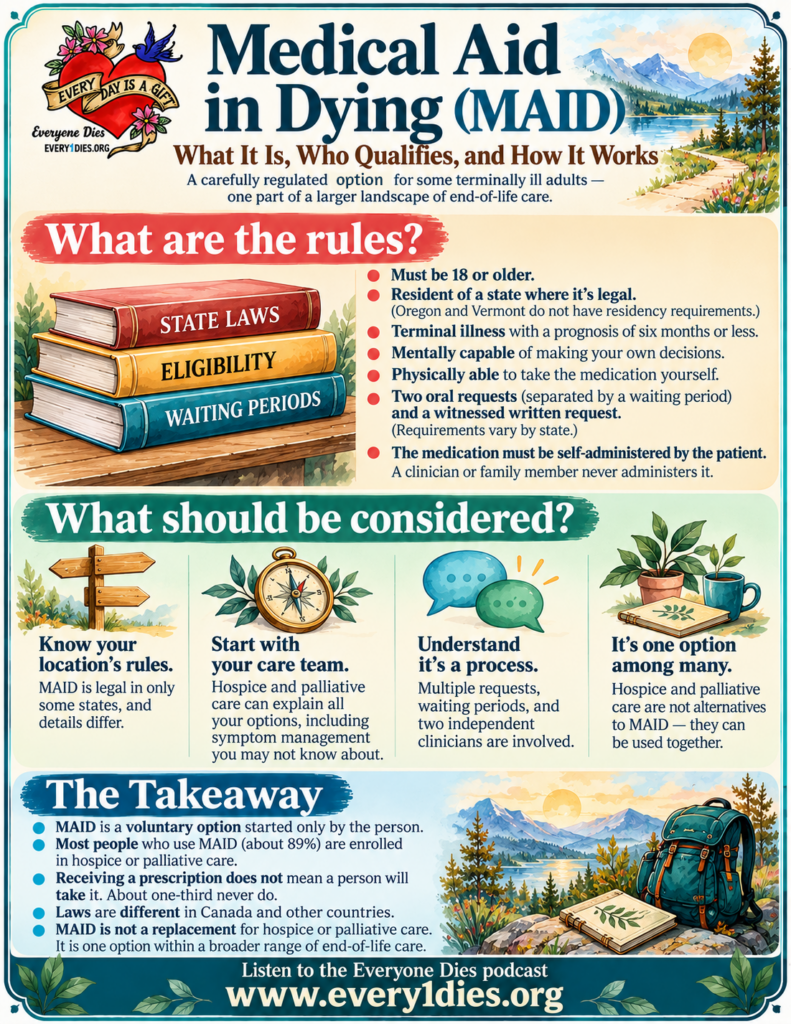
Across U.S. jurisdictions, the eligibility bar is set high to protect against impulse or coercion. While exact statutory rules differ by state, qualification generally requires that a person be:
- An adult: Age 18 or older.
- A qualified resident: Living in a jurisdiction where MAiD is legal (except in states like Oregon and Vermont without residency rules).
- Terminally ill: Diagnosed with an incurable, irreversible condition expected to cause death within six months, confirmed by medical judgment.
- Mentally capable: Retaining full decision-making capacity to make informed healthcare choices.
- Physically able: Capable of self-administering the medication.
- Acting voluntarily: Making the request freely without coercion.
Safeguards include confirmation of diagnosis, prognosis, and capacity by two independent clinicians (an attending and a consulting provider), built-in waiting periods between oral and written requests, and mandatory mental health evaluations if either clinician has concerns about decision-making capacity.
Medical Aid in Dying and Hospice Can Coexist
Medical aid in dying should be understood as one option within the broader landscape of end-of-life care, not as a replacement for hospice or palliative care. In fact, national utilization reporting indicates that 89% of people who used medical aid in dying were enrolled in hospice or palliative care services at the time of death.
Hospice and palliative care teams specialize in relieving pain and distressing symptoms while supporting patients and families. U.S. laws require clinicians to inform patients considering MAiD about all available alternatives, including comfort-focused care and symptom management.
How Canada and Other Countries Differ
The meaning and legal framework of MAiD vary significantly outside the United States. Canada legalized medical assistance in dying nationally in 2016 under a broader model:
- No terminal diagnosis required: Canadian law allows eligibility for individuals with a serious and incurable illness, disease, or disability causing an advanced, irreversible decline and enduring physical or psychological suffering.
- Clinician administration: Unlike the U.S., Canada permits physicians or nurse practitioners to administer the medication directly.
- Mental illness exclusion: Mental illness alone does not qualify someone for MAiD in Canada, an exclusion scheduled to remain in place until March 17, 2027.
European nations such as Switzerland, Belgium, and the Netherlands operate under their own distinct legal frameworks. Listeners should never assume that the term “MAiD” carries the same rules across borders.
Why Medical Aid in Dying Remains Controversial
Supporters of medical aid in dying emphasize patient autonomy—the principle that mentally capable adults facing terminal illness should have control over the timing and circumstances of their death. Critics, including some medical and palliative care organizations, raise ethical concerns regarding the traditional healing role of clinicians, potential coercion of vulnerable populations, and disparities in access to quality healthcare and social support.
Because healthcare professionals hold diverse views, conscientious objection provisions are built into state laws, ensuring no patient, clinician, or healthcare institution is forced to participate.
Five Things to Remember
- Know your location’s rules: Medical aid in dying is legal only in select jurisdictions, and eligibility and waiting-period requirements vary considerably.
- Start with your care team: Hospice and palliative care professionals can explain all available options for managing pain, symptoms, and emotional distress.
- Understand it is a process: Multiple requests, waiting periods, and evaluations by two independent clinicians are required safeguards.
- You remain in control: Obtaining a prescription does not mean you must use it; you can change your mind at any time.
- It is one option among many: Advance care planning, symptom management, and open conversations with loved ones help ensure your care aligns with your values.
Medical aid in dying raises profound questions about autonomy, protection, suffering, and dignity. Learning about end-of-life options before a crisis occurs gives patients and families time to ask questions and make informed choices. At Everyone Dies, our goal is to help you learn so you can plan, and plan so your death can be consistent with your values.
Every day is a gift.
Related Content:
- S1E44: “Mom’s Assisted Death”: A Daughter’s Response: Hear a deeply personal firsthand reflection on navigating a parent’s assisted death and what the experience looks like for loved ones left behind.
- S1E43: Euthanasia – Dying with Dignity: Explore the historical, ethical, and legal distinctions between euthanasia, dying with dignity, and end-of-life autonomy. Learn another perspective in “hastening death” by simply allowing natural processes.
- S1E03: What is Palliative Care?: Discover how palliative care wraps patients and families in comfort and symptom relief from the moment of serious diagnosis.
- S1E09: Advance Directives: Learn how to document your healthcare preferences clearly so your medical team and loved ones honor your values.
References:
- When they can’t die in their own home, some terminally ill patients are welcomed into someone else’s | Here & Now
- Patient Choices Vermont
- Transcript of Eric Dane’s Final Message To His Daughters and The World | Famous Last Words | Netflix
- MaiD Utilization Report: https://compassionandchoices.org/wp-content/uploads/2024/02/final_utilization-report-3.31.26.pdf
- Canada’s medical assistance in dying (MAID) law: https://canada.justice.gc.ca/eng/cj-jp/ad-am/
- Bloomer, M. J., Saffer, L., Hewitt, J., Johns, L., McAuliffe, D., & Bonner, A. (2024). Maybe for unbearable suffering: Diverse racial, ethnic and cultural perspectives of assisted dying. A scoping review. Palliative Medicine, 38(9), 968-980. https://doi.org/10.1177/02692163241268449
- Dorman, J.D., Raffin Bouchal, D.S., Wasylenko, E. and Sinclair, S. (2026), The Discourse of Medical Assistance in Dying and Its Relationship With Hospice Palliative Care in Canada: An Integrative Literature Review. J Adv Nurs, 82: 2067-2083. https://doi.org/10.1111/jan.17025
- New Law Expands End-of-Life Options for Terminally Ill New York Residents
Resources:
- For Non-Residents – Patient Choices Vermont
- More people want to come to Vermont for medical aid in dying than the system can handle | Vermont Public
- States Where Medical Aid in Dying is Authorized – Compassion & Choices
- Death with Dignity U.S. Legislative Status State Map

Use the Feedspot RSS reader to find more.

Everyone Dies: and yes, it is normal!

Everyone Dies (and yes, it is normal) is a story about a young boy named Jax who finds something special on the beach where he and his grandpa Pops are enjoying a wonderful day. Pops helps Jax understand that death is a normal part of life. This book provides an age appropriate, non-scary, comfortable way to introduce the important topic of mortality to a preschool child. Its simple explanation will last a lifetime. Autographed copies for sale at: www.everyonediesthebook.com. Also available at Amazon
Mourning Jewelry

We offer a way to memorialize your loved one or treasured pet with a piece of handmade jewelry. When people comment on it and the wearer can say for example “I received this when my mother died” which opens the conversation about this loss. All our jewelry is made with semi-precious stones and beads, vintage beads, and pearls. You can choose between earrings or bracelets and the color family. Learn More