
A familiar scent in an empty room, a vivid dream, or a sudden feeling of warmth—after-death communications (ADCs) are far more common than most people realize. This episode examines what modern grief research reveals about these experiences and how they help the bereaved heal.
In this Episode:
00:00 – Intro: When Grief Feels Like a Visit
02:43 – Recipe of the Week: Boo-Schetta Ghostly Caprese Bites
03:24 – Ronald Reagan, Football, & Unspoken Love: The Devotion of Joanne Bell
08:25 – Mediums, Unexpected Signs, & Modern After-Death Communication
11:02 – What Do After-Death Experiences Actually Do for the Bereaved?
20:23 – Jane Goodall’s “Famous Last Words”: Hope, Purpose, & What Lies Beyond
23:50 – Outro & Closing Reflections
Key Takeaways
- Understand the Science of ADCs: Learn why sensory and quasi-sensory experiences of the deceased are normal, widespread grief occurrences rather than mental health concerns.
- Discover the Role of “Continuing Bonds”: Explore how maintaining an ongoing psychological connection with a deceased loved one supports long-term emotional coping and healing.
- Reflect on Clinical Agnosticism: Gain insight into why modern grief therapists prioritize the comforting impact of an experience over proving or debunking its origin.
- Reduce Grief Shame: Discover why so many people stay silent about their experiences and how open, non-judgmental listening brings profound relief.
After-Death Communication and the Healing Power of Continuing Bonds
A Story That Raises an Interesting Question
In a September 2026 New York Times Opinion essay, senior editor Sarah Wildman described an unexpected telephone conversation with a cousin. The cousin told Wildman that she had spoken with a psychic medium who reportedly conveyed messages involving their grandmother and Wildman’s daughter, Orli, who had died at age 14.
Wildman and her cousin considered whether information about the family could have been discovered beforehand. At the same time, Wildman acknowledged something important about her own reaction: she did not particularly want to disprove what had happened. That response raises an important question about grief.
Rather than beginning with the question, “Was this communication actually from the person who died?” we can ask another question: “What effect does believing or experiencing this connection have on the person who is grieving?” Those are different questions, and science is better equipped to investigate the second one.
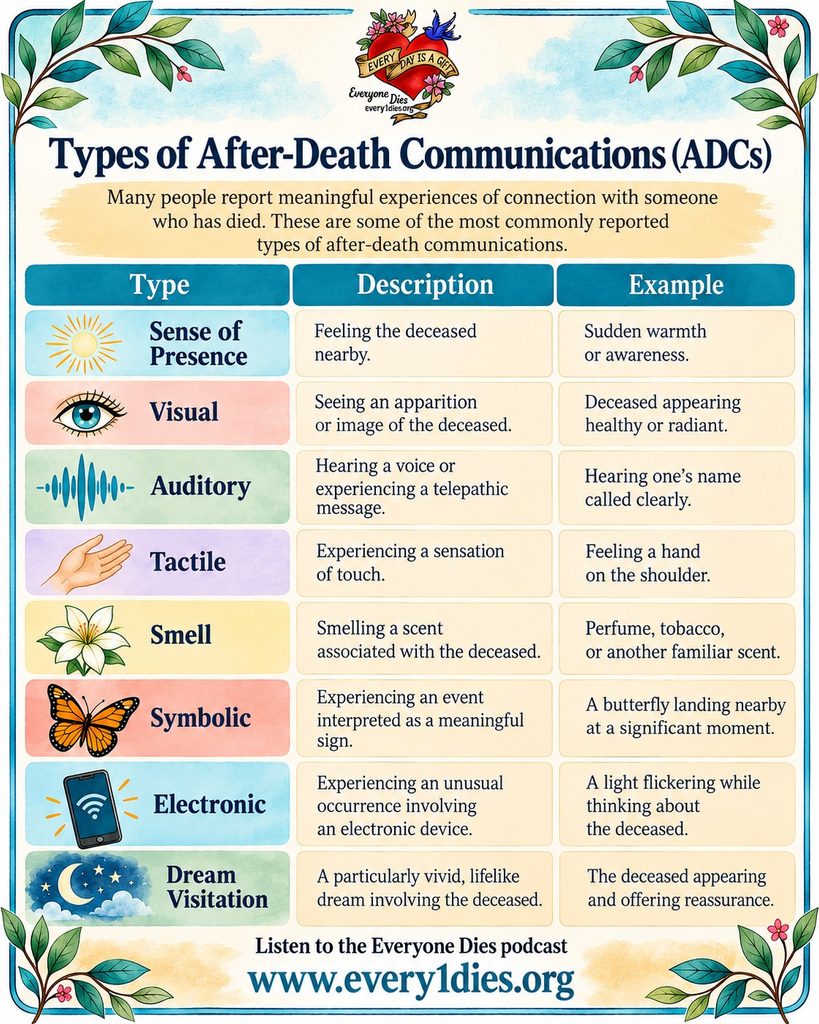
These Experiences Are More Common Than Many People Realize
It is not uncommon for bereaved people to experience at least one perception of a deceased relative or friend. The experiences take many forms:
- Sensory presences without seeing or hearing anything
- Visual, auditory, tactile, or olfactory experiences
- Vivid dreams that feel distinctly different from ordinary dreams
Importantly, having one of these experiences does not by itself indicate mental illness. An interdisciplinary review published in Schizophrenia Bulletin concluded that most sensory and quasi-sensory experiences of deceased people are benign and should be understood within the person’s individual, relational, cultural, and social context.
What Does the Newer Research Tell Us?
In 2026, Siobhán Sweeney and colleagues published a systematic review examining 14 qualitative studies involving 1,971 bereaved participants. Their findings suggest that ADCs were often described as emotionally restorative and meaningful. For many people, these occurrences provided:
- Comfort during acute distress
- Help in making sense of the loss
- Support in maintaining an ongoing connection with the person who died
However, the findings were not uniformly positive. Some experiences created uncertainty or distress. How people understood an ADC was influenced by their existing beliefs, their cultural environment, and the response they received when they told other people about it—which can be particularly important.
People sometimes hesitate to describe these experiences because they fear being judged, dismissed, or considered irrational. The research suggests that the reactions of other people can affect whether the experience becomes a source of comfort or an additional source of distress.
Continuing Bonds
Modern grief theory has moved away from the assumption that healthy grieving requires a person to detach emotionally from someone who died. Instead, researchers recognize the concept of continuing bonds. A relationship changes after death, but aspects of that relationship may remain part of a person’s life.
Someone may talk to a deceased spouse while driving, a daughter may make a recipe her mother taught her, or a person may feel comforted by a vivid dream. For some people, an ADC becomes another form of that continuing relationship.
This does not establish where the experience originates or whether consciousness survives death. Those are different questions. What researchers can study is the experience itself and its relationship to grief, coping, meaning, and well-being.
Listening Without Having to Explain
There may be a useful middle ground between insisting that an experience is supernatural and dismissing it as meaningless. A grieving person does not necessarily need someone else to determine what happened; they may simply need the freedom to describe what they experienced and what it meant to them.
For clinicians, family members, and friends, a useful response can begin with curiosity rather than judgment. Was the experience comforting? Was it frightening? What did it mean to the person? Did it change how they understood the death or their relationship with the person who died? Those questions allow us to respect the experience without making claims that available evidence cannot establish.
For many grieving people, the most important question may not be whether an after-death communication can be scientifically verified. It may be how that experience helps them understand loss, preserve connection, and continue living while carrying the relationship with them in a new way.
References:
- Joanne Eller Bell Obituary August 27, 2026 – Broadus-Raines Funeral Home
- The nurse who chided Reagan in the hospital, and other lives we’ve lost – The Washington Post
- Opinion | Go Ahead and Laugh at Mediums. They May Be On to Something. – The New York Times
- Sabucedo, P., Hayes, J., & Evans, C. (2026). Sensory experiences of the deceased in bereavement: history of a psychological concept. Mortality, 1–24. https://doi.org/10.1080/13576275.2026.2690491
- Sweeney, S., Ryan, P., Leahy, D., & Deering, H. (2026). The impact of after-death communications on grief and meaning-making among the bereaved: A qualitative systematic review. Death Studies, 1–18. https://doi.org/10.1080/07481187.2026.2626550
- Krause N. (2011). Reported Contact with the Dead, Religious Involvement, and Death Anxiety in Late Life. Review of religious research, 52(4), 347–364.
- Jane Goodall Interview in Famous Last Words Netflix Documentary – Netflix Tudum
Resources:
- Guided: The Secret Path to an Illuminated Life (The Path of Light Series): 9780593729571: Jackson, Laura Lynne: Books
- Signs: The Secret Language of the Universe: Jackson, Laura Lynne: 9780399591617: Amazon.com: Books
- ADCRF – After Death Communication Research Foundation
- Jane Goodall in her own https://www.washingtonpost.com/video/world/jane-goodall-in-her-own-words/2025/10/01/80403503-4763-41c7-a279-e73752b8c5e4_video.html
- How Does Famous Last Words Documentary on Netflix Work? Series with Gloria Steinem Eric Dane Explained – Netflix Tudum

Use the Feedspot RSS reader to find more.

Everyone Dies: and yes, it is normal!

Everyone Dies (and yes, it is normal) is a story about a young boy named Jax who finds something special on the beach where he and his grandpa Pops are enjoying a wonderful day. Pops helps Jax understand that death is a normal part of life. This book provides an age appropriate, non-scary, comfortable way to introduce the important topic of mortality to a preschool child. Its simple explanation will last a lifetime. Autographed copies for sale at: www.everyonediesthebook.com. Also available at Amazon
Mourning Jewelry

We offer a way to memorialize your loved one or treasured pet with a piece of handmade jewelry. When people comment on it and the wearer can say for example “I received this when my mother died” which opens the conversation about this loss. All our jewelry is made with semi-precious stones and beads, vintage beads, and pearls. You can choose between earrings or bracelets and the color family. Learn More